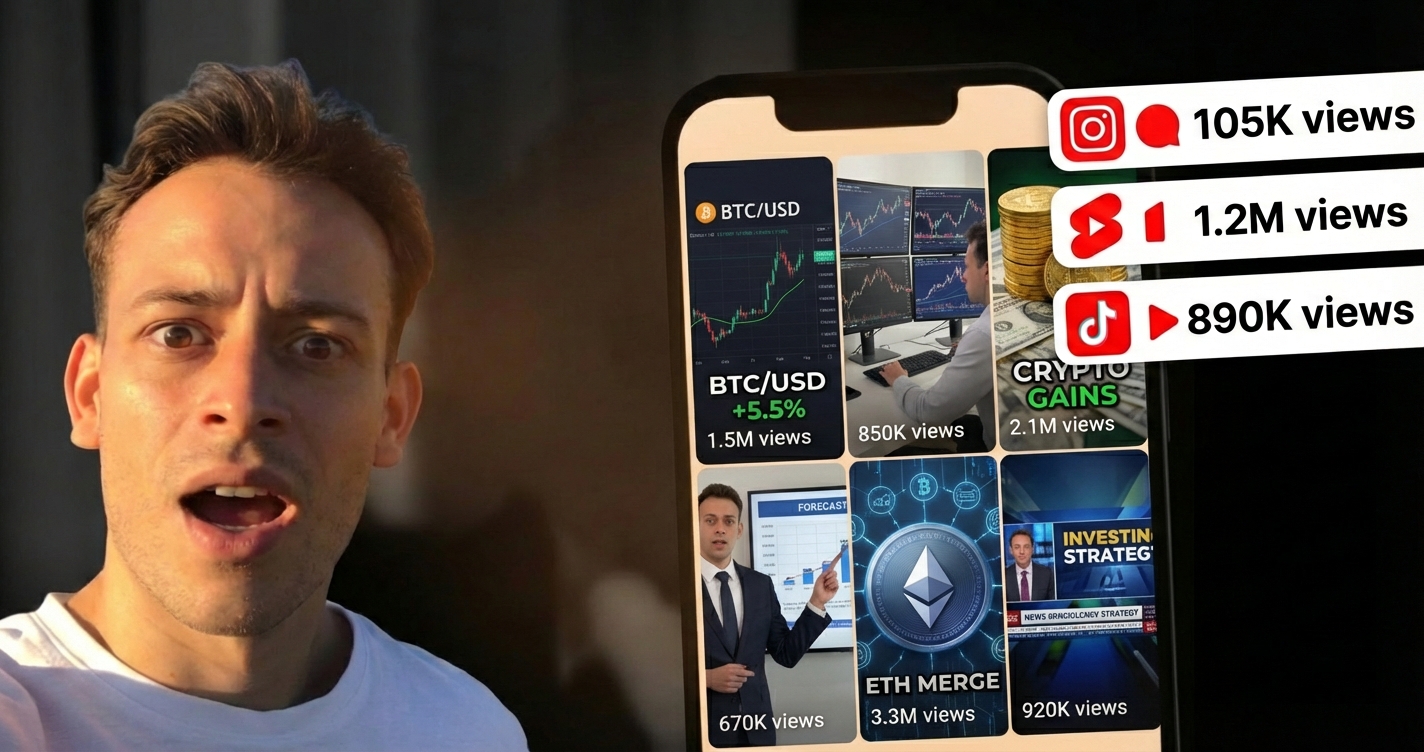
Clipping is one of the cheapest ways to get eyeballs on your crypto project right now. Take a podcast, a Twitter Space, a livestream, or an interview. Chop it into 15 to 60 second vertical clips and post them across TikTok, Instagram Reels, and YouTube Shorts. The CPMs are absurdly low. We're talking $0.30 to $2 CPM on organic clips, compared to $15 to $30 for TikTok ads in crypto and $20 to $40 for Meta in the same space.
But here's the thing nobody wants to admit. Clipping is not a conversion channel.
Think about it. You're watching a 30 second clip of someone explaining their take on a crypto topic from a podcast. There's no CTA. There's no product demo. There's no moment where someone says download the app. The viewer watches, maybe engages, and scrolls on.
And that's completely fine, as long as you know what you're buying. Clipping is a brand marketing play. It puts your brand, your team's voice, and your narrative in front of people who have never heard of you. Measuring it by sign-ups or token purchases is like measuring a billboard by app downloads. That's not what it's for.
This guide breaks down how to approach clipping strategically. The economics, the quality spectrum, and the matrix for finding the right balance between editing effort, content value, and output volume.
What Is Clipping. And Why Crypto Projects Use It
Clipping is the practice of taking long-form content and cutting it into short, vertical video clips optimised for social media. Think of it as content arbitrage. You're taking one piece of source material and extracting dozens of distribution-ready assets from it.
The source material can be anything. Podcast interviews, Twitter/X Spaces, YouTube livestreams, conference talks, AMAs, or even internal team calls. The output is a stream of 15 to 90 second vertical clips posted across TikTok, Reels, and Shorts.
Crypto has adopted clipping aggressively because the industry runs on narratives and opinions. When your CTO explains zero-knowledge proofs in a way that clicks, that's a clip. When your founder debates tokenomics on a podcast, that's a clip. When someone on your team breaks down why your approach to consensus is different, that's a clip.
None of those clips point to a product conversion. They're moments of insight, credibility, and personality. And that's exactly what builds brand awareness in crypto.
The Economics. Cheap Reach, Not Cheap Conversions
Let's be upfront about the numbers. Organic clipping consistently delivers some of the lowest CPMs in marketing. When a clip goes viral on TikTok, you can reach 100K to 500K people for essentially $0 in media spend.
| Channel | CPM |
|---|---|
| Organic Clipping | $0.30 to $2 |
| TikTok UGC (fresh accounts) | $0.40 to $4 |
| TikTok Ads (crypto) | $15 to $30 |
| Meta / Facebook Ads (crypto) | $20 to $40 |
| Crypto KOL / Influencer | $75 to $100+ |
The reach is unbeatable for the cost. But here's why conversion rates barely register.
- Most clips are extracted from conversations (podcasts, Spaces) where nobody is pitching a product. A team member giving their take on L2 scaling isn't dropping a sign-up link.
- The viewer doesn't arrive with purchase intent. They're scrolling, they stumble on a clip, they engage (or don't), and they move on.
- There's no natural CTA in clipped content. Unlike scripted UGC where you can build in a call to action, clips are moments from organic conversations.
This doesn't make clipping useless. It makes it a different tool. Use it for what it's good at. Putting your brand in front of people at the lowest possible cost. Brand awareness. Narrative control. Thought leadership.
The Clipping Quality Matrix
Here's a framework we use at KAIKA to think about clipping strategy. Most people think about clipping quality as a binary. Low quality vs. high quality. But it's actually a spectrum, and the right place on that spectrum depends on two things. How much editing effort you put in, and how entertaining or valuable the content itself is.
There's also a crucial third variable. Volume. The higher the editing quality, the fewer clips you can produce. A professional editor might produce 2 to 3 polished clips per day. An AI tool can produce 20 to 30. This trade-off is fundamental to your strategy.
We think of it as a 2x2 matrix.
| ⬆ High Content Value | ⬇ Low Content Value | |
|---|---|---|
| High Edit Quality |
⭐ THE SWEET SPOT
Great content + great editing = viral potential. Low volume but high impact. e.g. Clip A (polished edit), 12K views |
⚠ POLISHED BUT EMPTY
High effort, boring content. Looks great but nobody cares. Worst ROI on your time. |
| Low Edit Quality |
⚡ THE VOLUME PLAY
Great content, minimal editing. High volume, testing ground. Some of these will surprise you. e.g. Clip B (quick cut), 300 views (but you made 30 of them) |
❌ CONTENT LANDFILL
Boring content + lazy editing. This is what gives clipping a bad name. Avoid. |
The insight here is that content value matters more than editing quality. A raw, unedited clip of a genuinely interesting take will outperform a beautifully edited clip of someone saying nothing interesting. The editing amplifies the content. It doesn't replace it.
But volume is the hidden variable. When you invest in high editing quality, your output drops dramatically. A professional editor might turn around 2 to 3 clips per day. An AI clipping tool can generate 20 to 30. So the question isn't should I go high quality or low quality. It's what's the balance that maximises my total reach AND the quality of attention I get.
There's no universal answer. You have to discover it for your project, your content, and your audience.
The Quality Spectrum. Finding Your Balance
Stop thinking about low quality and high quality as two categories. Think of it as a spectrum with trade-offs at every point.
| AI Auto-Clip | Light Edit | Full Production | |
|---|---|---|---|
| Editing effort | ~5 min/clip | 15 to 30 min/clip | 1 to 3 hours/clip |
| Monthly volume | ~500 clips | 200 to 300 clips | ~50 clips |
| Cost per clip | $0.50 to $2 | $5 to $30 | $50 to $200 |
| Typical elements | Auto-captions, auto-crop | + hook text, trim, basic effects | + B-roll, sound design, custom captions, brand assets |
| Best for | Testing, volume, fresh accounts | Established clipper accounts | Brand account, hero content |
| Avg. watch time | Lower | Medium | Higher |
Here's how I think about it. Start at the left side of the spectrum (AI auto-clip, high volume). Use that to discover which content resonates. When you find a clip that performs, a take that gets engagement, a moment that sparks comments, then invest in re-editing that same moment at higher quality for your brand account.
Clip A is a good example of this. It's a polished edit. Thoughtful cuts, good pacing, visual elements that add to the message. It got 12K views. Compare that to Clip B, a quick auto-cut of similar content that got 300 views. The editing quality clearly made a difference in performance.
Clip A — Polished edit, 12K views
Clip B — Quick auto-cut, 300 views
But here's the nuance. Clip A took significantly more time and effort to produce. In the time it took to make that one clip, you could have produced 15 to 20 AI clips. Some of those AI clips might have hit 500, 1K, even 5K views on their own. The total reach of the volume approach might actually match or exceed the single polished clip.
That's why I say it's about balance. There's a balance between the topic (how inherently interesting or valuable the content is), the level of editing (how much production effort you invest), and the volume you can maintain. You need to discover where your sweet spot is, and it will be different for every project.
A Warning on Botted Clipping Accounts
This is something a lot of projects learn the hard way. Many clipping accounts in the crypto space are heavily botted. They inflate their follower counts, fake their engagement metrics, and charge you based on numbers that aren't real.
Before you pay a clipper to post on their account, do your due diligence. Look at their comment sections. Are the comments generic one-word responses. Do the same 20 accounts comment on every post. Are the follower-to-view ratios suspiciously off. These are red flags.
This is why having a healthy balance of owned channels (accounts you control) vs. paid collab accounts (clippers with their own audience) matters. Your owned accounts give you real data you can trust. Paid collabs give you distribution, but only if you're working with legitimate accounts.
A good rule of thumb is to start with your own accounts first. Build up your owned network. Then selectively add paid clipping partners once you've seen enough of the space to tell the real accounts from the fake ones.
Why You Should Start Your Own Fresh Accounts
One of the most underrated moves in crypto clipping is running your own network of fresh TikTok accounts. Most projects only think about posting on their brand account or paying clippers. But starting fresh accounts yourself gives you control, speed, and a volume advantage that neither of those options can match.
Here's why fresh accounts work so well.
- TikTok's new account boost. TikTok actively pushes content from new accounts to test whether they produce engaging content. Fresh accounts often get more initial reach per video than established accounts with thousands of followers. This is TikTok trying to discover whether your account is worth promoting.
- Risk mitigation. Crypto content gets flagged and shadowbanned regularly. If your brand account gets restricted, that's a major problem. If one of your 5 fresh accounts gets restricted, you close it and open a new one in 10 minutes. Zero downtime.
- Niche testing. Each fresh account can target a different content angle or audience niche. One account focuses on DeFi yield. Another on crypto for beginners. Another on market commentary. You're running parallel experiments to find what sticks.
- Algorithm diversity. Multiple accounts means TikTok's algorithm is showing your content to different audience pools. You're casting a wider net than any single account ever could.
The Volume Approach with Fresh Accounts
If you're AI savvy, start with 10 accounts. If you're not, start with 3 to 5. Either way, the playbook is the same.
- Set up your accounts. Each with a different content angle or niche focus. Give each one a clean profile with a clear bio.
- Warm up each account for 3 to 5 days. Before posting any content, spend 20 minutes per day per account following relevant creators, liking content in your niche, and leaving comments. This tells TikTok's algorithm what category your account belongs to.
- Use AI clipping tools to generate volume. Feed your long form content (podcasts, Spaces, interviews) into Opus Clip, Reap, or CapCut. Generate 20 to 40 clips per source video. Review them quickly, discard the obvious duds, and schedule the rest.
- Start with 1 to 2 posts per day per account. Don't go all in right away. Start with 1 to 2 clips per day, then test bumping it to 3. If you don't see a drop in performance, keep that cadence. If engagement drops, pull back. Let the data guide you.
- Monitor for 7 to 10 posts. If an account hasn't gained any traction after 7 to 10 clips, kill it and start a new one. Don't waste time trying to revive dead accounts.
- Double down on winners. When a clip works on one account, post the same clip across all your other accounts. The same content can perform differently for different audiences, and you want to squeeze every view out of a proven winner.
At scale with 10 accounts, you're producing 500+ clips per month. Most will get 100 to 500 views. Some will get 5K to 50K. A few might hit 100K+. The math works because the cost per clip is nearly zero (just the AI tool subscription) and the upside is uncapped.
How to Find Clippers and Editors
If you don't want to do all the clipping yourself, you have two options. Hire clippers (people who select and post clips from your content) or hire editors (people who create polished, high quality clips). They're different roles with different price points.
Finding Clippers
Clippers are people or pages that build audiences by posting clips from podcasts, Spaces, and streams. In crypto, there's a growing ecosystem of dedicated clip accounts.
Where to find them.
- TikTok and Instagram search. Search for clips from crypto podcasts you've appeared on or want to be associated with. The accounts posting those clips are your potential clippers. Check their follower count, engagement rates (comments and shares matter more than likes), and posting consistency.
- Twitter/X. Search for crypto clipper, crypto clips, or clipping for hire. Many clippers promote their services on X.
- Discord and Telegram communities. Crypto marketing Discords and freelancer Telegram groups often have clippers looking for work. Ask for portfolio examples and engagement metrics.
- Upwork and Fiverr. Search for TikTok clipping or short form video repurposing. Filter by reviews and ask for crypto-specific samples.
Finding Editors
Editors are the people who turn a raw clip into a polished, high quality piece of content. They handle the visual effects, captions, B-roll, sound design, and pacing.
Where to find them.
- Twitter/X portfolios. Many short form editors showcase their work on X. Search for short form editor portfolio or video editor for hire. The best editors will have reels showing before and after edits.
- Upwork. Filter for video editing with short form or TikTok specialisation. Look for editors with crypto or Web3 experience specifically.
- Referrals from other crypto projects. Ask projects whose clips you admire who edits for them. The crypto marketing space is small enough that word of mouth works well.
- Editing communities on Reddit. r/VideoEditing and r/editors have freelancers who specialise in short form. Post a job listing with your requirements.
The Performance-Based Model
There's another approach that's gaining traction. Instead of paying clippers a flat fee, you pay them on a performance basis. Something like $20 per 1,000 views, capped at a certain amount per clip.
This model lets you scale up an army of clippers without taking on massive upfront cost. You're only paying for results. The clippers are incentivised to make good content because their payout depends on performance. And you can work with 10, 20, even 50 clippers simultaneously because the risk per clipper is low.
The downside is that competitors can poach your clippers by offering a higher rate. If you're paying $20 per 1K views and a competitor offers $50, some clippers will jump ship. That's the nature of the model.
But here's the flip side. If it makes sense to take mindshare away from a competitor, paying that extra bit is worth it. If you know a competitor is running a big clipping campaign and you want to steal their distribution network, bumping your rate from $20 to $50 per 1K views can pull their clippers to your side. It's a market, and sometimes winning the market costs a premium.
The key is to start at $20 per 1K views, see who performs, and adjust rates for your best performers to keep them loyal.
What to Expect to Pay
Pricing varies widely based on quality, experience, and whether you're paying per clip or on retainer. Here's what the market looks like in 2026.
| Service | Per Clip | Monthly Retainer | What You Get |
|---|---|---|---|
| AI clipping (DIY) | $0.50 to $2 | $30 to $100 (tool sub) | Auto-generated clips, basic captions |
| Freelance clipper | $10 to $50 | $500 to $1,500 | Clip selection, posting, account management |
| Established clip account | $20 to $100 | $500 to $2,000 | Distribution to existing audience |
| Short form editor (light) | $15 to $50 | $500 to $2,000 | Hook text, trimming, effects, branded captions |
| Short form editor (full) | $50 to $200 | $1,500 to $5,000 | B-roll, sound design, custom graphics, brand assets |
| Performance-based clippers | $20 to $50 per 1K views | Varies | Volume clips, pay only for results |
| Agency (full service) | $100 to $500 | $3,000 to $10,000+ | Strategy, clipping, editing, account management, reporting |
A few notes on pricing.
- Per clip pricing works best when you're testing. You pay for what you use and can scale up or down quickly. Switch to retainer pricing once you've found a clipper or editor you trust and want consistent output.
- Some clippers and editors will accept token-based compensation or revenue sharing, especially if they believe in the project. This can work well for early stage projects with limited marketing budgets.
- Always ask for a test clip before committing to a retainer. Give them one piece of source content and see what they produce. This tells you more than any portfolio.
Understanding the CPM Model for Clipping
Most marketing channels price on CPM. Clipping doesn't have a fixed CPM because it's organic content, but you can calculate your effective CPM by dividing your total spend by your total impressions.
Here's what to expect when you're starting out.
- Monthly spend. $200 on AI tools + $1,000 on a freelance clipper = $1,200 total
- Monthly output. 150 clips across 5 accounts
- Monthly impressions. 500,000 (average ~3,300 views per clip)
- Starting CPM. $1,200 / 500 = $2.40
That $2.40 CPM is what you can realistically expect in the early days. It's already cheaper than most channels, but it's not the floor. As you get better at identifying which clips work, which topics resonate, and which accounts gain traction, your CPM drops. If even 5 out of 150 clips hit 50K+ views, your total impressions jump to 750K+ and your effective CPM drops to $1.60.
With the performance-based model, the math shifts. If you're paying $20 per 1K views, that's a $20 CPM on paper. But you're only paying for views you actually get, so there's zero waste. And if a clip goes viral and you've capped payment, your effective CPM can drop to well below $1.
The trade-off compared to other channels is control. With clipping, TikTok's algorithm decides who sees your content and there's no clickable link. That's why clipping is awareness, not conversion. You're optimising for maximum eyeballs at minimum cost, not for targeted action. Other channels give you more precision, but at 10x to 50x the cost per impression.
Why Clipping Is Brand Awareness, Not Conversion
I want to be very direct about this because I see projects get it wrong constantly. Clipping is not a conversion channel. Don't measure it like one.
Think about what most clipped content actually is. It's your team members on a podcast explaining their perspective on a topic. Your CTO talking about consensus mechanisms. Your head of growth discussing market trends. Your founder debating tokenomics with another founder.
None of these moments have a natural product CTA. Nobody on a podcast says and that's why you should download our app right now. If they did, it would feel forced and kill the clip's authenticity, which is the exact thing that makes clips work.
Clipping converts indirectly and over time. Someone sees 3 to 4 clips of your team sounding smart and credible. Weeks later, they hear your project name in a different context and think oh I've seen those guys, they know what they're talking about. That's the conversion path. It's brand recall, not direct response.
So what should you actually measure.
- Reach and impressions. How many people are seeing your brand.
- Engagement rate. Are people watching, commenting, sharing.
- Branded search volume. Are more people Googling your project name over time.
- Share of voice. How often does your brand appear in crypto social feeds vs. competitors.
- Follower growth. Across all the accounts in your clipping network.
Clipping is the layer that makes other parts of your marketing work better. When people finally do encounter your product through other channels, they'll already know your name.
Best Practices
After running clipping campaigns for crypto projects, here are the non-obvious lessons.
- Manufacture clippable content. This is the biggest unlock most projects miss. Don't just clip whatever content you happen to have. Record your podcasts and long-form content with clippable moments in mind. Before a recording, identify 5 to 10 talking points that would make great standalone clips. Structure the conversation so those moments happen naturally. The best clipping strategy starts before the camera turns on.
- The hook decides everything. Viewers decide in 2 to 3 seconds. Start with the most provocative or surprising statement. Cut all preamble.
- Captions are mandatory. Animated captions with keyword highlighting increase watch time significantly. AI tools handle this automatically.
- Repurpose your winners across all platforms. A clip that works on TikTok usually works on Reels and Shorts. Don't create platform-specific content until you have data to justify it.
- Cross-post winners across all accounts. When a clip works on one account, post it on all your other accounts too. Different audiences see different accounts, and a proven clip has a higher chance of performing again than an untested one.
- Evergreen clips keep working for months. A good clip can resurface in the algorithm weeks or months later. Invest in evergreen topics alongside timely content.
- Build a shared asset library. Google Drive or Notion with branded assets, logos, approved imagery, and colour palettes. Keep clips consistent even when different people are editing.
- Don't ignore YouTube Shorts. 70 billion daily views, less competitive for crypto, and the audience skews older and more investment-minded.
Finding Images and Visual Assets for Clips
The best performing clips layer in visual elements. Here's where to find assets.
- Screen recordings of your product for showing the actual product while someone explains it.
- Charts from CoinGecko, DeFi Llama, Dune Analytics for instant credibility with data-driven audiences.
- Memes and trending imagery because crypto is meme-driven and a well-placed meme overlay can 10x engagement.
- Stock footage from Pexels, Pixabay, Unsplash. Use sparingly. Authentic beats generic.
- AI-generated visuals from Midjourney or DALL-E for custom thumbnails and abstract concept visualisations.
Summary
Clipping is the cheapest brand awareness channel in crypto marketing right now. The CPMs are unbeatable. But it's a brand marketing play, not a conversion channel, and understanding that distinction is what separates a smart clipping strategy from wasted effort.
The framework.
- Use the matrix to evaluate every clip. Is the content valuable. Does the editing level match.
- Start your own fresh accounts for maximum volume and testing capacity at near zero cost.
- Watch out for botted accounts and keep a healthy balance of owned channels vs. paid collabs.
- Work with established clippers for distribution to existing crypto audiences.
- Consider performance-based pay to scale an army of clippers without massive upfront cost.
- Invest in high quality edits for your brand account and hero content.
- Manufacture clippable moments by planning your long-form content with clips in mind from the start.
- Find your balance on the quality spectrum. The right mix of editing effort, content value, and volume is different for every project.
- Measure awareness metrics, not conversions. Reach, engagement, branded search, share of voice.
Clipping won't get you sign-ups directly. But it will make everything else in your marketing work better because when people finally do encounter your product, they'll already know your name.
Ready to build your clipping machine.
We'll map out your content distribution strategy in a free 30-minute call.
Start Clipping